
As a major institutionalized scientific and technological exchange event under the framework of the China–Russia Expo and a key activity of the 2026–2027 “China–Russia Years of Education,” the 10th China–Russia Roundtable on New Technology R&D, Applied Scientific and Technological Cooperation, and Talent Cultivation was held at the HIT International Campus from May 17 to 19. The event was jointly organized by China’s Ministry of Science and Technology and Russia’s Ministry of Science and Higher Education, and co-hosted by the Heilongjiang Provincial Department of Science and Technology, Harbin Institute of Technology (HIT), and the International Union of Instrument Makers and Specialists in Information and Telecommunication Technologies of Russia. Zhu Xuehua, Director-General of the Department of International Cooperation of China’s Ministry of Science and Technology; Konstantin Mogilevsky, Deputy Minister of Science and Higher Education of Russia; Cong Li, Vice Governor of Heilongjiang Province; and Han Jiecai, President of HIT, attended the opening ceremony and delivered speeches.
Other distinguished guests attending related events included Gennady Popov, Vice President and Chairman of the Executive Committee of the International Union of Instrument Makers and Specialists in Information and Telecommunication Technologies of Russia; Chen Su, Director-General of the Heilongjiang Provincial Department of Science and Technology; Zhang Wentao, Director-General of the Inner Mongolia Department of Science and Technology; Vladimir Solodov, Governor of Kamchatka Krai, Russia; Natalia Vikulova, Minister of Science and Vocational Education of Zabaykalsky Krai, Russia; Andrey Potserintsev, Chairman of the Russian Fuel and Energy Complex Development Association and energy affairs expert of the Russian State Duma; Alexey Svishchev, Acting Rector of Amur State University; Yuri Marfin, Rector of Pacific National University; Vitaly Gladkikh, Vice Rector for Research, Innovation and Analytics of Moscow State University of Civil Engineering; Anton Yurmanov, Vice Rector of Murmansk Arctic University; Sergey Ivanchenko, First Vice President of Shenzhen MSU-BIT University; Ji Yong, President of Harbin Medical University; Wang Jingbo, President of Heilongjiang University; Cai Wei, Foreign Member of the Russian Academy of Engineering and Professor at Harbin University of Science and Technology; as well as HIT Vice Presidents Fan Feng and Liu Ting.
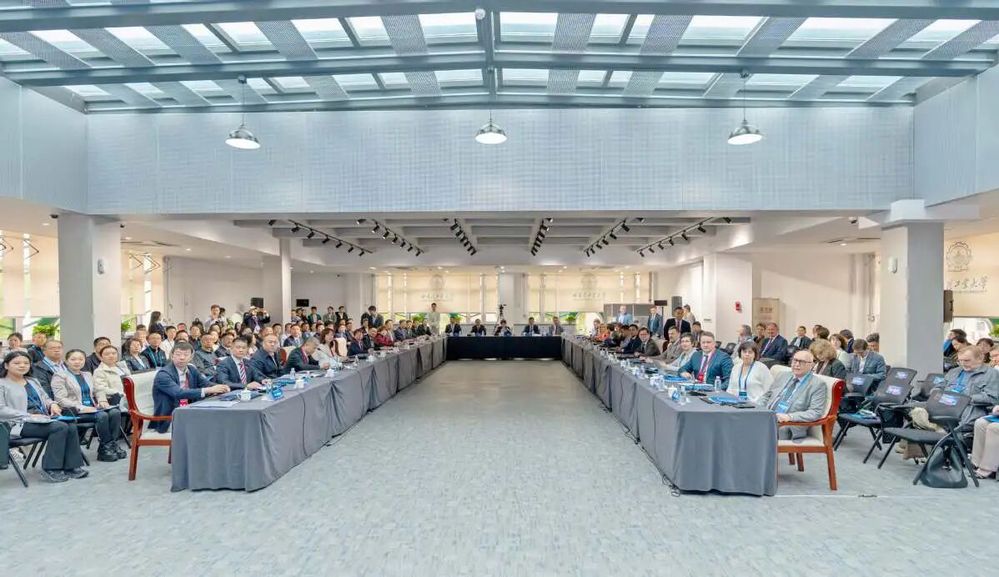
Conference Scene
Zhu Xuehua noted that under the strategic guidance of the two heads of state, China–Russia scientific and technological cooperation has continued to improve in quality and yield fruitful outcomes in recent years. He emphasized that the Chinese government has consistently placed innovation at the core of national development, and that China’s scientific community will continue to uphold the principles of openness, inclusiveness, mutual benefit, and win-win cooperation by deepening scientific exchanges and talent collaboration with Russia and other countries. He pointed out that Harbin, as a major hub of China’s old industrial base in Northeast China, carries a profound foundation for coordinated development with neighboring Russian regions. The gathering of representatives from the scientific and educational communities of both countries in Harbin to discuss cooperation in science, technology, and talent cultivation is therefore of great strategic significance. He expressed hope that all parties would take innovation as the vessel, cooperation as the sail, and talent as the oar, ride the waves of scientific and technological advancement, and jointly write a new chapter in the China–Russia comprehensive strategic partnership of coordination for a new era.
Konstantin Mogilevsky stated that in recent years, the scale of cooperation between Russia and China in the fields of basic and applied scientific research has continued to expand, the number of joint research projects has steadily increased, and collaboration between scientific research institutions of the two countries has become increasingly close. The two sides are also advancing the implementation of cooperation between their ministries of education on the construction and development of large-scale scientific facilities. The annual roundtable conference has become an effective platform for promoting bilateral scientific and technological cooperation. He emphasized that the participation of representatives from leading universities, research centers, and innovative enterprises from both countries in this year’s conference is especially significant in the context of the 2026–2027 “Russia–China Years of Education,” particularly regarding talent cultivation cooperation, and expressed confidence that the conference would achieve fruitful results through joint efforts.
Cong Li stated that Heilongjiang Province, rich in educational and scientific resources and endowed with a strong innovation foundation, stands at the forefront of China’s scientific and technological cooperation with Russia. In recent years, Heilongjiang has fully implemented the national strategy for cooperation with Russia by leveraging its geographic, scientific, and industrial advantages to continuously improve international science and technology cooperation mechanisms and build a new highland for opening-up toward the north. As a key science and technology event of the 10th China–Russia Expo, the conference aims to deepen exchanges and mutual learning in innovation and explore new ideas, models, and pathways for sustained and in-depth practical cooperation. She expressed hope that the conference would serve as a new starting point for further strengthening mutual trust, building consensus, upholding mutual benefit, deepening collaboration in scientific innovation, facilitating talent exchanges, and accelerating the commercialization of scientific achievements, to jointly write a new chapter in China–Russia coordinated scientific and technological development.
Han Jiecai stated that the all-round development of the China–Russia comprehensive strategic partnership of coordination for a new era has created broad platforms and unprecedented opportunities for bilateral cooperation in science, technology, and education. As one of the earliest Chinese universities to engage in cooperation with Russia, HIT has maintained long-standing exchanges with Russia’s higher education and engineering science communities and established stable partnerships with many top Russian universities and research institutions, achieving fruitful results. He noted that the topics of this year’s conference align closely not only with the scientific and technological development priorities of both countries, but also with the practical needs of industrial upgrading and regional coordinated development. He expressed hope that the conference would serve as an opportunity to inspire new ideas and strengthen cooperation consensus through in-depth exchanges, leading to more achievements in areas such as joint research platforms, collaborative breakthroughs in core technologies, commercialization of innovative outcomes, and joint talent cultivation.
Experts and enterprise representatives from universities and research institutions in both China and Russia—including the Yangtze River Delta National Technology Innovation Center, Zhejiang Tsinghua Yangtze River Delta Research Institute, Kazan Scientific Center of the Russian Academy of Sciences, Research Institute of Building Physics of the Russian Academy of Architecture and Construction Sciences, Bashkir State Medical University, Sechenov First Moscow State Medical University, Moscow Institute of Physics and Technology, Harbin Engineering University, Beidahuang Information Co., Ltd., Liuzhou OVM Machinery Co., Ltd., and Harbin Langsung Electric Co., Ltd.—conducted comprehensive discussions and thematic matchmaking activities. Topics included talent cultivation in high-tech development and application, cross-climate population health research and digital health management innovation, expansion of regional cooperation through the joint establishment of a China–Russia–Mongolia Science and Technology Innovation Cooperation Center, and the construction, intelligent building, and operation of high-quality housing in cold regions, as well as frontier areas such as new energy, new materials and advanced manufacturing technologies, information technology, artificial intelligence, robotics, transportation, and bioengineering. Professor Guo Anxin from HIT’s School of Civil Engineering and Professor Hu Ying from HIT’s Faculty of Life Sciences and Medicine delivered keynote presentations at the conference.
