
Recently, The team of Professor Zhou Zhongxiang and Professor Yuan Chengxun from the School of Physics, Harbin Institute of Technology have made significant progress in the field of surface-wave transmission on metasurface interfaces. Their research, titled “Realization of Spatiotemporal Photonic Crystals Based on Active Metasurface,” has been published in Laser & Photonics Reviews. The work successfully addresses the key scientific challenges in the experimental realization and practical application of spatiotemporal photonic crystals.
Spatiotemporal photonic crystals (STCs) are artificial materials whose dielectric parameters are periodically modulated in both space and time, opening up a new avenue for electromagnetic wave manipulation and field enhancement. However, due to the extreme complexity of experimental conditions, current implementations of STCs generally rely on temporal modulation of the electrical properties of closed systems (such as circuits or enclosed waveguides) or metasurfaces loaded with varactor diodes. The former lack interaction with free space and are therefore impractical for real-world applications, while the latter have thus far been realized mainly in photonics time crystal systems, the one-dimensional counterpart of STCs.To overcome this technical bottleneck, the team has, for the first time, experimentally achieved precise control of two-dimensional metasurface interface surface-wave transmission under temporal modulation, as well as the bandgap closing phenomenon in the corresponding dispersion relation. Through a combination of theoretical modeling, electromagnetic filed simulations, and experimental measurements, they innovatively proposed a method to emulate surface-wave transport in spatiotemporal photonic crystals using metasurface structures.
In their study, they designed a spatiotemporal metasurface structure loaded with varactor diodes. By tuning the applied DC bias voltage and temporal modulation parameters, the eigenfrequency of surface waves can be shifted and the metasurface impedance can be modulated, leading to bandgap closure in the dispersion relation of surface waves and resulting in abrupt transitions in surface-wave propagation along the interface. The bandgap closure mechanism of spatiotemporal metasurface proposed in this work provides an experimental platform for potential applications such as ultrafast switching and short-pulse generation based on spatiotemporal metasurfaces.
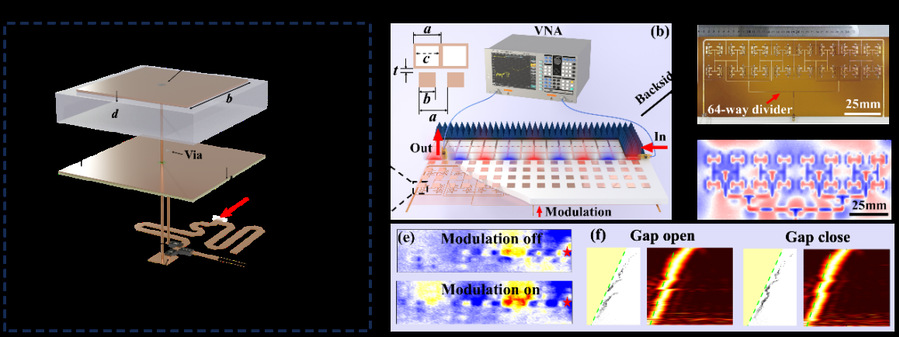
Design of a two-dimensional spatiotemporal metasurface structure
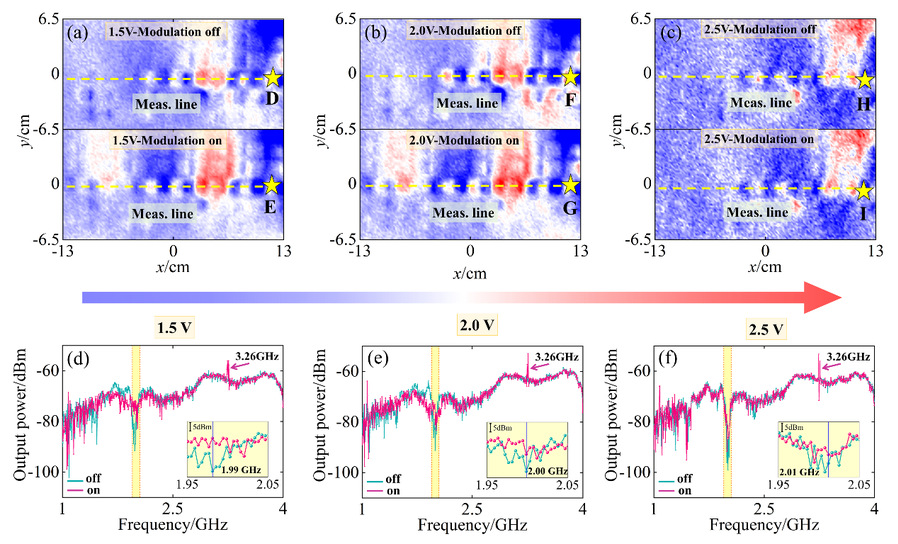
Near-field measurement results of surface-wave transmission on the metasurface interface
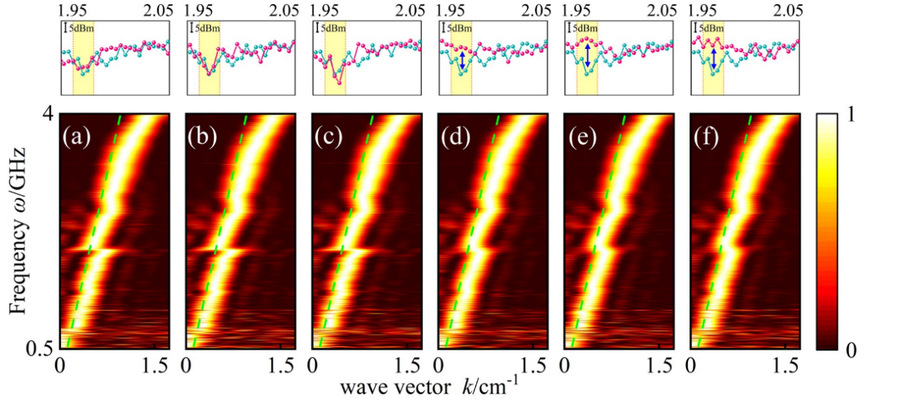
Experimental results of bandgap closure in the time-modulated metasurface
This research represents a continuation and extension of the team’s long-term efforts in the field of plasma photonic crystals. Previously, the team has published a series of foundational studies in leading journals such as APL Photonics, Optics Letters, and Physical Review B.
Harbin Institute of Technology is the sole corresponding institution for this paper. Ye Xin, a Ph.D. candidate from the School of Physics, is the first author. Prof. Yuan Chengxun, Prof. Zhou Zhongxiang, and Assoc. Prof. Yao Jingfeng serve as the corresponding authors. Ph.D. candidate Wang Yongge and Assoc. Prof. Wang Ying also contributed to the research.This work was supported by the National Key Research and Development Program of China, the National Natural Science Foundation of China, and the Fundamental Research Funds for the Central Universities.
Link to the paper: https://doi.org/10.1002/lpor.202401345
