
Recently, the research team led by Professor Weiqiang Ding from the School of Physics at Harbin Institute of Technology has made a significant breakthrough in optical computing research. The related findings were published in Optica under the title “Partially Coherent Diffractive Optical Neural Network”. By introducing the spatial coherence of light fields into diffractive optical neural networks (DONNs), the research team addressed the limitation that existing DONNs only operate under coherent light. This advancement holds substantial value for the practical application of DONNs in real-world environments.
As an important implementation approach for optical computing, DONNs have achieved remarkable results in fields such as image processing and object recognition in recent years. However, most current DONNs rely heavily on highly coherent light sources (e.g., lasers), which restricts their practical application in environments with incoherent light sources. To tackle this issue, Professor Ding’s team innovatively introduced parameters related to spatial coherence length into the design of DONNs from the perspective of the spatial coherence dimension of light. They proposed a training algorithm suitable for light sources with arbitrary spatial coherence. This method overcomes the limitation of traditional training algorithms, which are only applicable to coherent light, enabling effective training of DONNs under partially coherent or even incoherent light source conditions.
Experimental results demonstrate that, when tested under different coherence light sources, DONNs trained under partially coherent light exhibit higher robustness compared to those trained under coherent light. For instance, in tasks involving handwritten digit recognition, the recognition accuracy of DONNs trained under partially coherent conditions consistently remained above 82%, while the accuracy of networks trained under coherent light conditions significantly dropped to 26%. This achievement not only notably enhances the applicability of DONNs in environments with low or even no coherence but also provides a new perspective for fundamental theoretical research in this field.
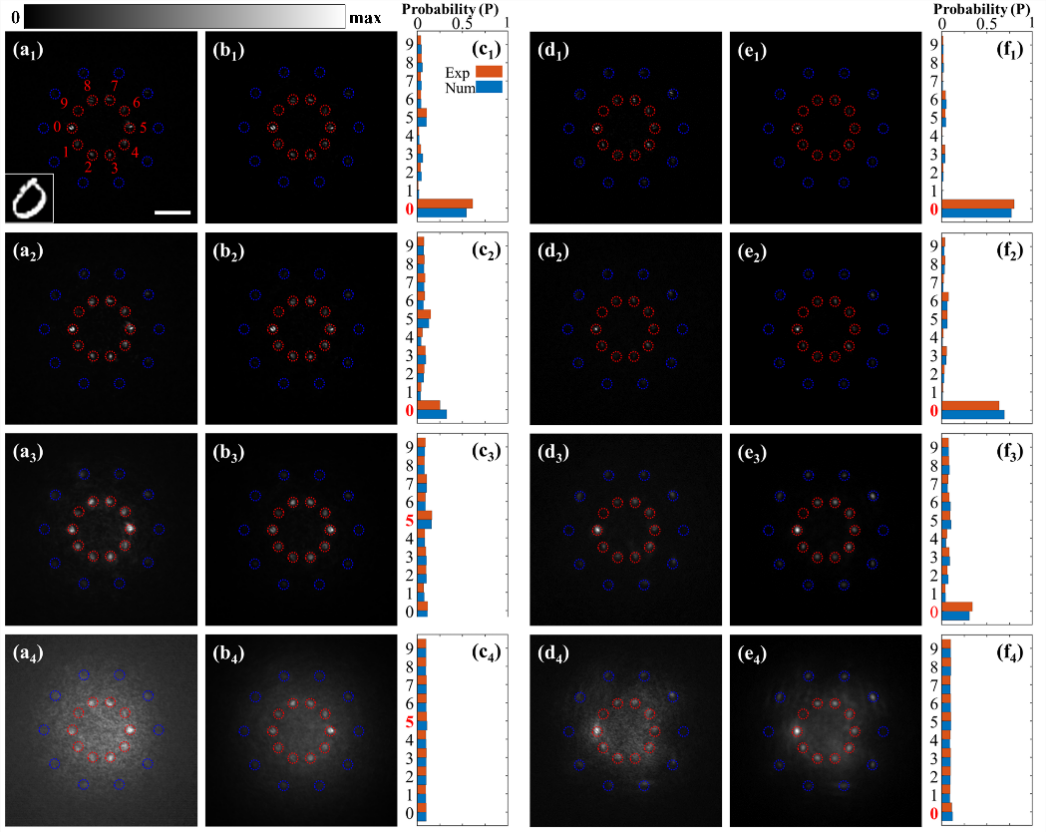
Fig. 1 Output results of DONNs under different coherence light sources in simulation and experiment.
Harbin Institute of Technology is the first author affiliation of the work. Assistant Researcher Qi Jia from the School of Physics is the first author, while Professor Weiqiang Ding and Professor Jian Wang from the School of Physics, Professor Cheng-Wei Qiu from the National University of Singapore, and Professor Gu Min from the University of Shanghai for Science and Technology serve as co-corresponding authors.
This research was supported by the National Natural Science Foundation of China and the Heilongjiang Provincial Outstanding Youth Fund Project.
Link to the work: https://doi.org/10.1364/OPTICA.531919
